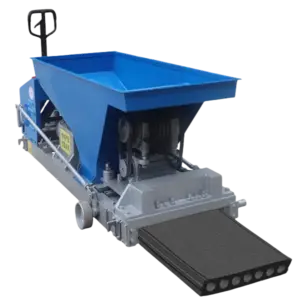
Comment fonctionne une machine à fabriquer des dalles préfabriquées en béton ? Guide complet [2026]
Par Young Zhang, PDG de Henan Kelai Industrial Co., Ltd. | Plus de 10 ans d'expérience dans la fabrication de machines pour le béton préfabriqué
A machine à fabriquer des dalles préfabriquées en béton constitue l'un des investissements les plus importants qu'un fabricant du secteur de la construction puisse réaliser. Mais avant de s'engager à acquérir une machine ou une ligne de production, il est essentiel de bien comprendre comment Il est essentiel de comprendre comment cela fonctionne — et ce qui distingue un système hautement performant d'un système peu performant.
Dans ce guide, nous détaillons le principe de fonctionnement complet des machines de fabrication de dalles préfabriquées en béton, en couvrant toutes les étapes de production, de la préparation des matières premières à l'empilage des dalles finies. Nous comparons également les différents types de machines, expliquons les principaux paramètres techniques et proposons un cadre d'achat pratique fondé sur deux décennies d'expérience dans le domaine de la fabrication.
Qu'est-ce qu'une machine à dalles préfabriquées en béton ?
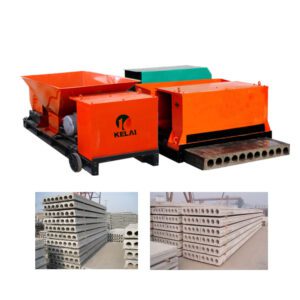
A machine à fabriquer des dalles préfabriquées en béton Il s'agit d'équipements industriels conçus pour produire des dalles de béton standardisées — dalles alvéolaires, dalles pleines ou dalles précontraintes — dans un environnement contrôlé en usine. Plutôt que de couler les dalles sur place, la fabrication en préfabriqué permet aux fabricants d'obtenir des dimensions homogènes, une résistance supérieure et une mise en œuvre plus rapide une fois les dalles livrées sur les chantiers.
Ces machines sont largement utilisées dans :
- Bâtiments industriels et entrepôts
- Complexes d'appartements résidentiels
- Centres commerciaux
- Écoles, hôpitaux et infrastructures publiques
- Parkings et ponts
Les machines modernes de fabrication de dalles préfabriquées automatisent cinq tâches essentielles : le malaxage et l'alimentation en béton, la mise en place des barres d'armature ou des fils d'armature, le compactage par vibration, le durcissement et le démoulage/découpage. Le degré d'automatisation varie selon les modèles, mais la séquence de production reste la même quel que soit le type de machine.
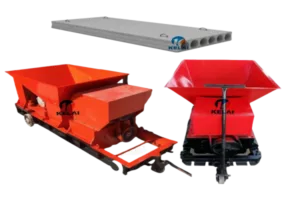
Fonctionnement d'une machine à dalles en béton préfabriquées : étape par étape
Étape 1 – Préparation du mélange de béton
Chaque dalle est issue d'un mélange de béton dont la composition est soigneusement calculée. Le ciment, le sable, les granulats grossiers (gravier), l'eau et, le cas échéant, des adjuvants chimiques sont pesés et mélangés dans un centrale à béton ou un mélangeur intégré à la chaîne de production.
La composition du mélange a une incidence directe sur les performances de la dalle :
- Dalles standard utiliser un rapport eau/ciment typique compris entre 0,40 et 0,45
- Dalles précontraintes nécessitent un rapport eau/ciment plus faible (environ 0,35) et une résistance à la compression plus élevée (C40–C50)
- Dalles alvéolées utiliser un mélange plus sec et plus rigide afin de préserver la géométrie des vides pendant l'extrusion
Les machines Kelai sont compatibles avec le béton ordinaire, le béton à haute performance et le béton à granulats recyclés, ce qui leur permet de s'adapter à la disponibilité locale des matériaux et aux spécifications des projets.
Étape 2 – Mise en place de l'armature en acier et du précontraint
Avant de couler le béton dans le coffrage, il faut mettre en place l'armature. Il existe deux méthodes principales :
Armature standard en barres d'armature : Des barres d'acier ou des treillis soudés sont placés manuellement ou automatiquement à l'intérieur de la cavité du moule. Cette méthode est utilisée pour les dalles pleines et les panneaux de plancher standard.
Mise en place des câbles/cordons de précontrainte : Des torons en acier à haute résistance et à faible relaxation (généralement de classe 1860 MPa) sont disposés sur toute la longueur du lit de coulée et mis en tension à un niveau de contrainte spécifié — généralement compris entre 70 et 75% de la résistance à la traction maximale de l'acier — avant le coulage du béton.
Une fois que le béton a pris et durci, la tension est relâchée. L’acier tend à se raccourcir, ce qui exerce une compression interne sur le béton. Cette précontrainte améliore considérablement la capacité portante de la dalle et permet d’obtenir des portées plus longues (de 4,2 m à 18 m) sans avoir recours à des poutres supplémentaires.
Les machines de fabrication de dalles précontraintes — telles que l'extrudeuse à poussée de Kelai — utilisent des lignes de coulée de grande longueur (généralement de 80 à 120 m) permettant de couler plusieurs dalles en une seule opération continue.
Étape 3 – Coulage et coffrage du béton
Il s'agit de l'étape mécanique déterminante qui présente les différences les plus marquées entre les différents types de machines.
Type d'extrusion / de poussée : Un système de vis sans fin propulse le mélange de béton vers l'avant à travers un moule profilé (matrice). Les vis sans fin tournent à grande vitesse, broyant et compactant le béton à mesure qu'il traverse la tête de formage. La machine se propulse le long des câbles précontraints en utilisant la force de réaction du béton repoussé vers l'arrière — aucun rail d'entraînement externe n'est nécessaire. La vitesse de production est généralement comprise entre 1,2 et 1,5 m/min.
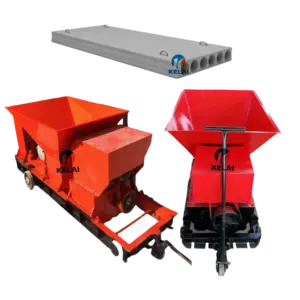
Type de vibration (coffrage glissant) : Le béton est coulé dans le moule, puis compacté à l'aide d'un système de vibration à haute fréquence intégré. La machine se déplace le long du lit de coulée tandis que les vibrations densifient le mélange. Cette méthode est particulièrement adaptée aux dalles alvéolaires présentant des géométries de vides complexes.
Type de moule / lit de coulée : Pour la fabrication de pièces de forme sur mesure ou en petites séries, le béton est coulé dans des moules fixes posés sur un plateau plat. Cette méthode permet de réaliser des finitions architecturales, des dalles nervurées et des dimensions hors normes.
Étape 4 – Compactage par vibration
La vibration joue un rôle essentiel dans la qualité de la dalle. Les poches d'air emprisonnées dans le béton créent des points de faiblesse pouvant entraîner l'apparition de fissures ou une défaillance prématurée. La vibration expulse l'air emprisonné et garantit que le mélange remplit uniformément chaque partie de la cavité du coffrage.
Les machines Kelai utilisent des vibrateurs à moyenne fréquence (100 Hz) comme source de vibration. Une vibration à plus haute fréquence — par rapport aux systèmes standard à 50 Hz — permet d'obtenir un compactage plus fin, une surface de dalle plus lisse et une économie d'environ 30 à 50 kg de ciment par mètre cube de béton, sans compromettre la résistance.
Dans la machine de type à poussée, le moule intérieur comporte 6 à 7 tubes vibrants, chacun doté de noyaux vibrants excentriques rotatifs entraînés par des moteurs. La combinaison de la pression d'extrusion par vis et des vibrations excentriques internes permet d'obtenir une plaque présentant une densité élevée et une grande régularité dimensionnelle.
Étape 5 – Durcissement
Une fois moulées, les dalles fraîches doivent être mises en cure à une température et un taux d'humidité adéquats afin d'atteindre leur résistance à la compression maximale. Les méthodes de cure comprennent :
- Séchage à température ambiante : Recouvrir les dalles d'une bâche en plastique ou de toile de jute humide et les laisser sécher à température ambiante pendant 24 à 48 heures avant de les découper. Convient aux climats chauds.
- Séchage à la vapeur : Les enceintes ou tentes chauffées permettent d'élever la température ambiante à 60–80 °C, ce qui accélère le développement de la résistance. Les dalles atteignent généralement la résistance nécessaire à la découpe en 8 à 12 heures. Cette méthode est utile pour la production à grand volume ou dans les climats froids.
- Chambres de durcissement intégrées : Certaines chaînes de production sont équipées de tunnels de séchage intégrés qui maintiennent automatiquement une température et un taux d'humidité contrôlés.
Dans le cas des dalles précontraintes, la découpe ne peut commencer tant que le béton n'a pas atteint une résistance à la compression minimale — généralement comprise entre 25 et 30 MPa —, telle que vérifiée par des cubs d'essai coulés parallèlement aux dalles.
Étape 6 – Démoulage, découpe et empilage
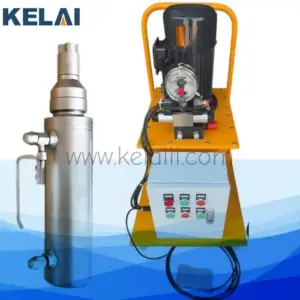
Libération de la précontrainte : Dans le cas des dalles précontraintes, les câbles d'acier sont libérés (soit par oxycoupage, soit par libération hydraulique) une fois que la résistance requise est vérifiée. La précontrainte se transmet alors au béton, induisant ainsi la force de compression prévue.
Découpe : Une scie à béton à lame diamantée — généralement montée sur rail machine de découpe automatique — découpe le ruban de dalle continu en panneaux individuels de la longueur spécifiée. La machine de découpe de Kelai permet de réaliser des découpes à la lame diamantée sur du béton précontraint à haute résistance, ce qui garantit des extrémités nettes et d’angle droit.
Démoulage (pour les dalles moulées) : Les parois du moule sont démoulées par un système hydraulique ou mécanique, et les dalles sont extraites à l'aide de ponts roulants ou de tables basculantes.
Empilage et transport : Les dalles finies sont empilées dans l'ordre à l'aide de systèmes d'empilage automatisés ou d'élingues de ponts roulants. Un empilage correct (avec des poutres de soutien en bois placées aux emplacements prévus) permet d'éviter tout bombement ou fissuration pendant le stockage et le transport.
Types de machines pour la fabrication de dalles en béton préfabriquées
Extrudeuse vs. machine à vibration (machine à coffrage glissant)
| Fonctionnalité | Extrudeuse | Machine à coffrage glissant |
|---|---|---|
| Procédé de formage | Pression de la vis sans fin | Glissement du moule + vibrations |
| Consistance du béton | Sec, raide | Demi-sec |
| Vitesse de production | 1,2 à 1,5 m/min | 1,0–1,3 m/min |
| Idéal pour | À âme creuse, précontraint | Profilés creux, plus larges |
| Longueur du lit de coulée | 80 à 120 m | 80 à 150 m |
| Niveau d'automatisation | Haut | Haut |
Ces deux procédés sont utilisés pour la production de précontraints en ligne continue. Les extrudeuses ont tendance à produire des dalles plus denses en raison de l'action de moulage sous pression, tandis que les machines à coffrage glissant offrent davantage de souplesse en matière de géométrie de la section transversale.
Machine à dalles creuses vs. Machine à dalles monobloc
Machines pour la fabrication de dalles alvéolaires permettent de fabriquer des dalles comportant des alvéoles longitudinales, ce qui réduit leur poids de 30 à 50% par rapport à des dalles pleines équivalentes. Elles sont idéales pour les structures à grande portée, car elles réduisent la charge morte et améliorent l'isolation thermique et acoustique.
Machines pour dalles monoblocs permettent de fabriquer des panneaux à section transversale uniforme, adaptés aux portées courtes, aux panneaux muraux et aux applications où la formation de vides n'est pas envisageable.
Kelai propose des machines adaptées à ces deux types de production, avec des configurations de moules personnalisables permettant de fabriquer des dalles d'une largeur comprise entre 600 mm et 1 200 mm et d'une épaisseur comprise entre 120 mm et 400 mm.
Paramètres techniques clés à connaître
Lorsque vous évaluez une machine de fabrication de dalles en béton préfabriquées, examinez attentivement les caractéristiques techniques suivantes :
| Paramètres | Ce que cela signifie | Aire de répartition typique du kelai |
|---|---|---|
| Vitesse de production | Mètres linéaires de dalle coulée par minute | 1,2 à 1,5 m/min |
| Largeur de la dalle | Gamme de largeurs de panneaux que la machine peut former | 600 à 1 200 mm |
| Épaisseur de la dalle | Épaisseur minimale et maximale des dalles pouvant être produites | 120 à 400 mm |
| Longueur du lit de coulée | Durée totale d'un cycle de production | 80 à 120 m |
| Fréquence du vibrateur | Plus la fréquence (Hz) est élevée, plus le compactage est fin | 100 Hz |
| Consommation électrique | Puissance totale installée de la machine | 37 à 75 kW |
| Économie de ciment | Réduction par rapport aux méthodes de moulage traditionnelles | 30 à 50 kg/m³ |
| Rendement de production vs. travail manuel | Multiplicateur de vitesse par rapport aux méthodes traditionnelles | 3 à 5 fois plus rapide |
Comment choisir la bonne machine pour la fabrication de dalles préfabriquées en béton
Choisir une machine inadaptée à votre application est une erreur courante et coûteuse. Tenez compte de ces quatre facteurs :
1. Type de dalle : Fabriquez-vous des dalles alvéolaires, des dalles pleines ou des panneaux précontraints ? C'est ce qui détermine si vous avez besoin d'une extrudeuse, d'une machine à coffrage glissant ou d'un système de moulage.
2. Résultat attendu : Calculez la surface de dalles requise par jour ou par mois. Une seule extrudeuse Kelai équipée d’un lit de coulée de 100 m peut produire environ 200 à 400 m² de dalles alvéolaires par jour, en fonction de l’épaisseur des dalles et du temps de durcissement.
3. Dimensions du site : Les lignes de coulée en continu (80 à 120 m) nécessitent une surface au sol importante. Si l'espace disponible dans votre usine est limité, les systèmes de coulée en moule offrent davantage de flexibilité.
4. Approvisionnement en béton : Les extrudeuses et les machines à coffrage glissant nécessitent un approvisionnement constant en béton sec dosé avec précision. Prévoyez l'achat d'une centrale à béton adaptée si vous n'en disposez pas déjà.
5. Exigences en matière de portée : Pour les portées supérieures à 6 m, il est généralement nécessaire d'utiliser des dalles alvéolaires précontraintes. Assurez-vous que la machine prend en charge la précontrainte par câble long et que votre site peut accueillir un système de culées de précontrainte.
Applications des dalles préfabriquées en béton
Les dalles produites par des machines de fabrication de dalles en béton préfabriquées sont utilisées dans un large éventail de types de construction :
- Bâtiments industriels : Entrepôts, usines et centres logistiques — où de grandes portées sans obstacle sont nécessaires et où la rapidité de construction est une priorité.
- Construction résidentielle : Des immeubles d'habitation à plusieurs étages, dans lesquels les systèmes de plancher standardisés permettent de réduire considérablement la durée des travaux et les coûts de main-d'œuvre.
- Structures commerciales : Les centres commerciaux, les immeubles de bureaux et les complexes à usage mixte bénéficient de la rapidité de mise en œuvre et de la cohérence structurelle des systèmes de planchers préfabriqués.
- Infrastructures : Les tabliers de ponts, les parkings à étages et les quais de gare recourent de plus en plus à des dalles préfabriquées précontraintes en raison de leur capacité à couvrir de grandes portées et de leur durabilité.
Foire aux questions
Q : Quel est le principe de fonctionnement d'une machine de fabrication de dalles en béton préfabriquées ? Une machine à dalles préfabriquées en béton fonctionne en poussant ou en extrudant un mélange de béton ferme à travers un moule profilé, à l'aide de vis sans fin ou d'un système de formage par vibration, tout en y incorporant simultanément des armatures en acier. La machine se déplace le long du lit de coulée et laisse derrière elle un ruban de dalles en béton moulées, qui sont ensuite mises en cure, découpées à la longueur souhaitée et empilées en vue de leur livraison.
Q : Quelle est la différence entre une extrudeuse et une machine à moulage par glissement ? Une extrudeuse utilise des vis sans fin rotatives pour exercer une pression et pousser le béton à travers une matrice de formage, tandis qu’une machine à coffrage glissant compacte le béton par vibration à mesure que la machine avance. Les deux procédés permettent de fabriquer des dalles alvéolaires précontraintes, mais les extrudeuses produisent généralement des dalles plus denses, tandis que les machines à coffrage glissant offrent une plus grande souplesse dans la conception de la section transversale.
Q : À quelle vitesse une machine de fabrication de dalles en béton préfabriquées produit-elle des dalles ? Les extrudeuses à poussée de Kelai fonctionnent à une vitesse comprise entre 1,2 et 1,5 mètre par minute. Sur un lit de coulée de 100 mètres, un cycle de production permet d’obtenir environ 100 mètres linéaires de plaque. Avec le durcissement à la vapeur, une usine peut réaliser 2 à 3 cycles de production par jour.
Q : Quelle quantité de béton permet d'économiser une machine à dalles préfabriquées par rapport aux méthodes traditionnelles ? La technologie de compactage par vibration de Kelai permet d'économiser environ 30 à 50 kg de ciment par mètre cube de béton par rapport au coulage manuel traditionnel, sans compromettre la résistance. Le rendement de production est 3 à 5 fois supérieur à celui des méthodes conventionnelles.
Q : Quel entretien une machine à dalles en béton préfabriquées nécessite-t-elle ? Les principales tâches d'entretien comprennent le nettoyage quotidien des composants du moule et de la vis sans fin afin d'éviter l'accumulation de béton, la lubrification périodique de toutes les pièces mobiles, l'inspection et le remplacement des manchons de vis sans fin résistants à l'usure (généralement tous les 6 à 12 mois, en fonction du volume de production), ainsi que des contrôles réguliers des systèmes hydrauliques et électriques.
Q : Puis-je produire des dalles d'épaisseurs différentes avec une seule machine ? Oui. La plupart des machines Kelai prennent en charge des configurations de moules interchangeables, ce qui permet à une même machine de produire des dalles de différentes épaisseurs et largeurs en changeant la tête de formage et la disposition des tubes internes. La machine s'adapte ainsi à un large éventail de spécifications de projet.
Pourquoi choisir la machine de fabrication de dalles en béton préfabriquées de Kelai ?
La société Henan Kelai Industrial Co., Ltd. fabrique des machines pour le béton préfabriqué depuis plus de 10 ans et fournit des lignes de production à des clients en Asie du Sud-Est, au Moyen-Orient, en Afrique et en Europe de l'Est.
Les machines de fabrication de dalles en béton préfabriquées de Kelai offrent :
- Plusieurs types de dalles pris en charge : dalles alvéolaires, dalles pleines, dalles précontraintes et panneaux composites isolants
- L'épaisseur des dalles varie de 120 mm à 400 mm, et leur largeur de 600 mm à 1 200 mm
- Système de vibration à moyenne fréquence (100 Hz) pour un compactage optimal et une réduction de la consommation de ciment
- Prise en charge complète de la chaîne de production : centrale à béton, lit de coulée, machine de découpe et système d'empilage
- Disponibilité à long terme des pièces de rechange et assistance technique sur site
- Configurations de moules personnalisables pour répondre aux exigences spécifiques de chaque projet
Vous souhaitez évaluer une machine de fabrication de dalles en béton préfabriquées pour votre site de production ? Contactez notre équipe d'ingénieurs pour bénéficier d'une consultation technique gratuite et d'un devis pour l'équipement.
Vous souhaitez en savoir plus sur ?
Découvrez les lignes de production de brames complètes, les machines personnalisées et le service après-vente sur le site :
🌐 www.kelaiii.com | 🌐 www.cnkelaiii.com
📲 WhatsApp : +86 17788171295