
Home / Blog / Prestressing Equipment for Hollow Core Slabs
How Prestressing Equipment Supports Hollow Core Slab Production
The extruder gets the attention, but the slab only works because the steel was tensioned correctly first. Here is what the tensioning side of the line does and what to check before you buy it.
By KELAI Precast Machinery · · 7 min read
A hollow core slab is thin for its span. It manages that because the concrete is squeezed in compression by tensioned steel before the slab ever carries a floor load. Without that, the voids that save weight would also make the slab cracked and floppy.
That squeezing force comes from prestressing equipment for hollow core slabs. This article explains what that equipment does at each stage of production, what usually goes wrong when it is poorly matched to the line, and how to choose it.
1. Why hollow core slabs are prestressed
Concrete is strong in compression and weak in tension. A slab spanning between supports wants to bend, and the bottom face goes into tension. Plain concrete would crack there under a modest load.
Prestressing fixes this ahead of time. The steel runs the length of the slab, held under high tension while the concrete sets around it. When the force is released, the steel tries to shorten and pushes the concrete into compression. Later, when a load bends the slab, that built-in compression has to be used up before the bottom face goes into tension.
The result is a slab that spans further, deflects less and stays crack-controlled with less material. This is the reason hollow cores are almost always prestressed products, and the reason the tensioning equipment deserves as much thought as the forming machine.
2. What prestressing equipment for hollow core slabs includes
On a long-bed line, the prestressing equipment is more than a single jack. It usually consists of:
- Hydraulic jacks that pull the wires or strands to the design force
- A hydraulic power unit that drives the jacks
- Measuring devices for force and elongation
- Anchorage hardware, such as grips and chucks, that holds the steel at each end
- End abutments on the casting bed that take the load
- Feeding and handling gear for laying out the steel along the bed
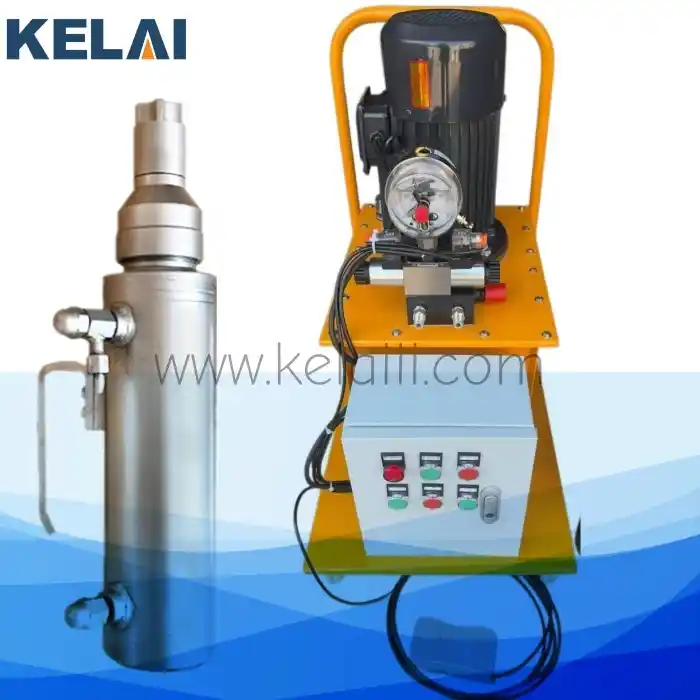
For wire and strand lines, a dedicated prestressing steel wire tension machine covers the pulling and measuring. The same product family is also shown on our global site as a prestressed steel wire tensioning machine.
KELAI tension machine: main technical parameters(Customizable)
| Parameter | Value |
|---|---|
| Applicable steel | Steel wires and strands, 5-25 mm |
| Tension force | 150KN/250KN/270 kN |
| Pulling stroke | 200-1200 mm |
The machine is mainly used on wire lines, and it can also tension steel strands. Parameters differ between models, so please contact us for the details of the model that fits your line.
3. Five Jobs of Prestressing Equipment for Hollow Core Slabs
| Job | What it means in production |
|---|---|
| 1. Apply the force | Pull each wire or strand to the specified tension along the full bed length |
| 2. Keep it uniform | Give every wire or strand a consistent force, so the slab is not loaded unevenly |
| 3. Hold it | Anchors and abutments keep the force steady while concrete is placed, compacted and cured |
| 4. Prove it | Measure force and elongation so the result can be checked against the design |
| 5. Release it safely | Transfer the force to the concrete in a controlled way once release strength is confirmed |
Prestressing equipment for hollow core slabs has to do all five well. If any one of these fails, the slab quality suffers, even when the extruder and mix are perfect. That is why we always look at the tensioning setup together with the rest of the line, not as an add-on.
4. Where tensioning fits in the production cycle
- Lay out the steelPull the wires or strands along the clean bed, from one abutment to the other.
- Tension to the design forceJack each wire or strand to the required force and check elongation against the expected value.
- Place and compact the concreteThe forming machine runs along the bed over the tensioned steel. The steel must stay at force while this happens.
- CureThe concrete gains strength with the steel still held at tension.
- Confirm release strengthTest the concrete. Do not release anything until it has reached the specified strength.
- Release the forceTransfer the force to the concrete following the approved procedure, then cut the slabs to length.
Notice how much of the cycle depends on the steel staying at force. A forming machine that vibrates the whole bed puts real demand on the anchors, so the tensioning system and the extruder need to be specified together. Our hollow core slab machine page shows the forming side of the same line.
5. What goes wrong when tensioning is weak
Problems rarely appear as a dramatic failure. They show up as quality drift:
- Uneven force between wires leads to slabs that camber differently from one another, which makes site installation harder.
- Steel slipping in the anchors loses part of the prestress, so the slab does not perform as designed.
- Poor force records mean you cannot prove a batch was made correctly when a customer or inspector asks.
- Rough or sudden release can crack the ends of the slabs and shock the bed.
- Slow, manual tensioning turns the setup into the bottleneck, so a fast extruder sits idle between runs.
Worth remembering: a slab can look perfect and still be under-prestressed. Good equipment and good records are what let you trust the product that left the bed.
6. How to Choose Prestressing Equipment for Hollow Core Slabs
Before comparing prices on prestressing equipment for hollow core slabs, settle these points:
| Check | Why it matters |
|---|---|
| Steel type and diameter | Jacks, grips and anchors are built for a specific steel size. Confirm that your wire or strand diameter falls within the machine's range (5-18 mm on our machine). |
| Force per wire or strand | The machine must reach your design force with margin, not at its limit. Our standard machine is rated at 270 kN. |
| Measurement accuracy | You need reliable force and elongation readings for quality records. |
| Bed length and abutment design | Equipment must suit your bed, and the abutments must carry the total force. |
| Speed and labor | Setup time per bed affects daily output and crew size. |
| Support and spare parts | Grips and seals wear. Ask how fast replacements arrive. |
Share your steel specification and bed layout early. With that, we can confirm which of our tensioning machines suits your slab range. For a broader view of the full equipment list, read our global guide to hollow core slab production line equipment, or see our precast concrete slab making machine page.
7. Safety basics
A tensioned wire or strand stores a large amount of energy. Treat the bed as a hazardous area while steel is under force.
- Keep people out of the line of the steel and the ends of the bed during tensioning and release.
- Use guards and anchors rated for the force, and inspect grips and chucks regularly.
- Release force only after release strength is confirmed, and follow the approved procedure for the sequence.
- Train operators on the specific equipment and keep maintenance records.
Always follow the engineering design and the safety standards that apply in your country.
8. Frequently asked questions
What is prestressing equipment for hollow core slabs?
It is the set of machines that tensions the steel wires or strands along the casting bed before concrete is placed. It normally includes hydraulic jacks, a power unit, force and elongation measuring devices, anchorage hardware and end abutments.
Why are hollow core slabs prestressed?
Prestressing puts the concrete into compression before the slab carries any load. That lets a relatively thin slab with hollow cores span long distances while keeping cracking and deflection under control.
When is the prestressing force released?
Only after the concrete has reached the specified release strength, confirmed by testing, and following the approved release procedure.
Can the same tensioning machine handle both wire and strand?
Often yes, but it depends on the machine. Jacks, anchors and grips are designed for a given steel type and size range. KELAI tension machines are mainly used on wire lines and can also tension steel strands, with applicable steel sizes of 5-18 mm. Confirm compatibility with your steel specification before choosing a machine.
What should I tell a supplier when asking about tensioning equipment?
Share the steel type and diameter, the required force per wire or strand, bed length, slab range and output target, so the supplier can match the equipment to your line.
Need Prestressing Equipment for Hollow Core Slabs?
Tell us your steel specification, bed length and output target. Our engineers will suggest a tensioning setup that fits your hollow core slab line.
Contact KELAI View tension machine