Concrete Wall Panel Installation Machine: Applications in India and Why Kelai’s Hydraulic Lifting Machine Leads the Market
Introduction
India’s construction sector is shifting fast. The combined pressure of large-scale government housing programs, Smart City projects, rapid urbanization, and a persistent skilled labor shortage is forcing developers and contractors to move away from traditional masonry methods and toward industrialized, prefabricated building systems.
Precast concrete wall panels are now widely adopted across residential, commercial, and industrial projects throughout India — but the wall panel itself is only half the equation. The other half is how efficiently and safely those panels are installed on-site. This is where the concrete wall panel installation machine becomes the pivotal piece of equipment that separates high-performing construction teams from those still battling manual inefficiency.
This guide is written for developers, contractors, and precast operations managers in India who want a clear, practical framework for understanding precast wall panel installation machines — and who want to know why the hydraulic lifting machines manufactured by Henan Kelai Industrial Co., Ltd. are trusted by construction teams across more than 30 countries worldwide.
Why a Concrete Wall Panel Installation Machine Is Now Essential in India
Traditional wall panel installation in India relies heavily on manual labor: teams of workers physically carrying, tilting, and positioning heavy precast panels using basic ropes, timber props, and manual scaffolding. This approach creates serious problems at scale:
- Speed bottleneck: Manual installation is slow. On projects requiring hundreds of panels per floor, manual methods cannot match the output rate of modern precast production lines.
- Inconsistent alignment: Human error during panel positioning leads to misaligned joints, gaps, and costly rework — especially problematic in high-precision residential builds.
- Workplace injury risk: Handling precast panels weighing 500 kg to 1,500 kg manually is one of the leading causes of on-site injury in India’s construction sector.
- Labor dependency: India’s skilled construction labor force is increasingly mobile and unpredictable. Projects depending entirely on manual panel erection are vulnerable to workforce disruptions.
A dedicated concrete wall panel installation machine eliminates each of these vulnerabilities. It mechanizes the entire panel handling sequence — transport, lifting, rotation, positioning, and clamping — replacing eight to ten manual workers with one operator and one machine, while delivering faster installation, higher positional accuracy, and a dramatically safer working environment.
“The true value of a high-quality precast wall panel is only fully unlocked when it is installed with precision. That precision begins with the right installation machine.”
Step 1: Understand What a Concrete Wall Panel Installation Machine Does
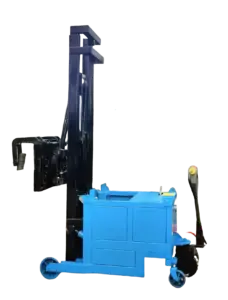
A concrete wall panel installation machine — also called a hydraulic wall panel lifting machine or precast panel erector — is purpose-built equipment that automates the movement, erection, and precise positioning of precast concrete wall panels on a construction site.
The machine handles the full installation workflow:
🔹 Horizontal Transport
The machine picks up panels from the storage stack in a horizontal position and transports them to the installation location. Battery-powered electric drive systems allow the machine to navigate narrow corridors, apartment rooms, and confined basement spaces that forklifts cannot access.
🔹 Hydraulic Lifting and Rotation
Using a hydraulic cylinder system powered by an onboard battery (typically DC 48V), the machine rotates the panel from horizontal to vertical — a 90-degree lift that a team of manual laborers would struggle to perform safely with a panel weighing over 500 kg.
🔹 Precise Positioning
Five-link hydraulic directional valves control the machine’s full range of micro-positioning movements: up/down, left/right lateral shift, forward/backward, and 360-degree rotation. This allows the operator to fine-tune panel position to within millimeters, ensuring perfect joint alignment with adjacent panels.
🔹 Hydraulic Clamping
Once positioned, a hydraulic clamp secures the panel in place, holding it stable during the grouting or adhesive bonding stage without the need for temporary timber props or manual support.
Step 2: Identify Your Installation Scenario
Not every construction site has the same spatial constraints or panel specifications. Before investing in a precast wall panel installation machine, map your project’s installation environment against the key variables:
| Installation Scenario | Key Constraint | Recommended Machine Type |
|---|---|---|
| High-rise residential apartments | Narrow room dimensions; low ceiling clearance | Compact trolley model with short mast |
| Ground-floor commercial fit-out | Open floor plan; heavier panels | Mid-range model with high load capacity |
| Industrial warehouse or factory | Large panels; long spans | Heavy-duty model; max 1,500 kg capacity |
| Basement or underground facility | Very low headroom; confined access | Ultra-compact model with low-profile design |
| Outdoor boundary wall installation | Uneven terrain; long panel runs | Robust outdoor model with wide-tread tyres |
| Hospital or cleanroom | Vibration-sensitive environment | Smooth hydraulic operation; low-noise model |
Understanding your installation scenario upfront prevents costly equipment mismatches — and ensures the machine you purchase can access every area of your site without workflow interruptions.
Step 3: Know the Key Technical Features That Matter
When evaluating any concrete wall panel installation machine, these are the technical parameters that determine day-to-day performance on Indian construction sites:
🔹 Maximum Load Capacity
Kelai’s range spans from 1,000 kg to 1,500 kg maximum panel weight. Confirm the heaviest panel type in your project and select a machine rated above that weight with a sufficient safety margin.
🔹 Maximum Panel Height
Panels used in Indian residential and commercial projects typically range from 2.8 m to 4.5 m in height. Kelai’s machines support panels up to 7,500 mm (7.5 m) in height — accommodating even double-height industrial spaces or atrium walls.
🔹 Battery Life and Charging
Onsite charging infrastructure in India is variable. Kelai’s machines use a 48V DC drive battery that supports 8–10 continuous hours of operation on a single 3–5 hour charge — sufficient for a full working shift without mid-day interruption. The charger accepts 120–230 VAC / 50–60 Hz, making it compatible with Indian power supply standards.
🔹 360-Degree Rotation
This function allows panels to be installed both horizontally (as ceiling panels or lintels) and vertically (as wall panels) from the same machine, without repositioning. On complex projects with varied panel orientations, 360-degree rotation is a critical operational efficiency feature.
🔹 Lateral Side Shift (Left/Right)
The left/right hydraulic side shift enables the machine to nudge panels laterally after lifting — essential for aligning panel edges precisely with adjacent panels without having to reposition the entire machine.
🔹 Drive System
The electric drive system (powered by the same 48V battery) allows the machine to self-propel forward, backward, left, and right via a steering handle, with rear-wheel steering and rear-wheel braking for operator control and safety.
Step 4: Evaluate Safety and Compliance Requirements
Safety on Indian construction sites is regulated under the Building and Other Construction Workers (Regulation of Employment and Conditions of Service) Act and related state-level regulations. Mechanizing heavy panel handling through a precast wall panel installation machine directly supports compliance with on-site safety obligations. Key safety features to verify in any machine include:
- Hydraulic lock system: Prevents uncontrolled panel descent in the event of hydraulic pressure loss
- Power-off brake: Automatically engages when the drive system is de-energized, preventing uncontrolled machine movement
- Safety non-slip rubber pad: Stabilizes the machine base on smooth concrete floors
- Weighted base: Lowers the machine’s center of gravity to prevent tipping when lifting heavy or tall panels
- Reversing reminder / alarm: Alerts nearby workers when the machine reverses direction
- Widened drive axle: Improves lateral stability on sloped or uneven floors
Kelai’s hydraulic wall panel lifting machines incorporate all of the above safety systems as standard features — making them compliant with international safety standards and appropriate for regulated construction environments in India.
Step 5: Match the Right Model to Your Project Scale
Henan Kelai Industrial Co., Ltd. manufactures more than ten models of concrete wall panel installation machines, each designed for a specific combination of panel weight, installation height, and site configuration. Below is a simplified model selection guide:
| Kelai Model | Key Capability | Best Application |
|---|---|---|
| KL07 | Hand clamp with rotation; hydraulic and mechanical variants | Thin, lightweight partition panels; splice installation |
| KL08 | Double-side clamps; high installation height; no lateral shift | Heavy-duty solid panels in open floor layouts |
| KL09 | Single-side clamp + left/right shift + front drive | Heavy panels; confined spaces; high-wall installation |
| Compact trolley model | Ultra-narrow footprint; low mast height | Apartment rooms and corridors with limited ceiling clearance |
| Heavy-duty outdoor model | Max 1,500 kg capacity; all-terrain tyres | Industrial boundary walls; outdoor site installation |
For buyers unsure which model suits their project, Kelai’s technical team provides pre-sale consultation based on panel dimensions, project type, and site specifications — recommending the optimal model before purchase.
Step 6: Calculate the ROI of Mechanized Panel Installation
The business case for investing in a concrete wall panel installation machine is straightforward when the numbers are laid out clearly.
Traditional manual installation (per panel):
- Workers required: 6–10 per panel installation
- Average installation time per panel: 25–40 minutes
- Injury risk: High (manual handling of 500–1,500 kg panels)
- Panel damage rate: Moderate (from manual handling errors)
- Daily output (per team): 15–25 panels
Mechanized installation with a hydraulic machine (per panel):
- Operators required: 1–2 per machine
- Average installation time per panel: 8–12 minutes
- Injury risk: Low (fully mechanized handling)
- Panel damage rate: Very low (hydraulic precision positioning)
- Daily output (per machine): 50–80 panels
| Factor | Manual Installation | Hydraulic Machine |
|---|---|---|
| Labor per panel | 6–10 workers | 1–2 operators |
| Installation speed | 25–40 min/panel | 8–12 min/panel |
| Daily panel output | 15–25 panels | 50–80 panels |
| Panel damage risk | Moderate | Very low |
| Worker injury risk | High | Low |
| Long-term cost trend | Rising (labor costs) | Declining (efficiency gains) |
For Indian contractors operating in an environment of rising labor costs and tightening project margins, switching from manual to mechanized panel installation typically delivers full return on equipment investment within 6–12 months, depending on project volume.
Common On-Site Challenges and How to Solve Them
Even with quality equipment, installation teams encounter predictable challenges. Planning ahead reduces their impact:
Challenge 1: Machine cannot enter narrow doorways or corridors Caused by using a full-size model in a confined apartment layout. Solution: Specify the exact minimum corridor width and doorway clearance to Kelai’s sales team — compact trolley models are designed precisely for this constraint.
Challenge 2: Panel slipping during clamping Usually caused by worn rubber clamp pads or incorrect clamping pressure setting. Solution: Inspect clamp pads weekly; adjust hydraulic clamping pressure to manufacturer specification for the panel weight being handled.
Challenge 3: Battery runs out mid-shift Caused by insufficient charging time or battery degradation. Solution: Establish a charging schedule (3–5 hours overnight); maintain a spare battery for high-output operations; test battery capacity monthly.
Challenge 4: Misalignment at panel joints Caused by rushing the lateral positioning step. Solution: Use laser positioning guides alongside the machine to establish reference lines before lifting; train operators to always confirm alignment before releasing the hydraulic clamp.
Challenge 5: Machine instability on sloped or debris-covered floors Caused by poor site preparation. Solution: Ensure casting bed areas and installation zones are cleared and leveled before bringing the machine in; use rubber anti-slip base pads on sloped surfaces.
Kelai’s Hydraulic Wall Panel Lifting Machine: A Complete Product Overview
Henan Kelai Industrial Co., Ltd. launched its first generation of hydraulic wall panel installation machines in 2011. Over the past decade-plus, continuous product development driven by real customer feedback has produced a range of more than ten models — making Kelai one of the most experienced and comprehensive concrete wall panel installation machine manufacturers in the global market.
Core System Architecture
Kelai’s hydraulic wall panel lifting machine integrates two power systems:
Electric Drive System (DC 48V battery) Powers the self-propelled movement of the machine across the construction site. The widened electric drive axle reduces floor-level vibration and significantly lowers the labor intensity of moving heavy panels across large floor areas.
Hydraulic Power System (Onboard hydraulic oil pump) Generates high-pressure hydraulic oil through a five-link directional valve to independently control six operational functions:
- Vertical lifting (up/down)
- Panel tilt support (85-degree inclined support for transport)
- Left/right lateral shift
- 360-degree panel rotation
- Hydraulic clamping (panel grip)
- Rear hydraulic tilt support (machine stabilization)
All six functions are controlled via a compact handheld control device, allowing the single operator to manage the entire installation sequence from a safe standing position adjacent to the panel.
Key Specifications at a Glance
| Specification | Detail |
|---|---|
| Power supply | DC 48V battery; charging 120–230 VAC / 50–60 Hz |
| Continuous operating time | 8–10 hours per full charge |
| Charging time | 3–5 hours |
| Maximum panel weight | Up to 1,500 kg (model dependent) |
| Maximum panel width | Up to 1,200 mm |
| Maximum panel height | Up to 7,500 mm |
| Drive system | Electric; self-propelled; rear-wheel steering and braking |
| Rotation | 360 degrees (horizontal and vertical installation) |
| Safety features | Hydraulic lock, power-off brake, anti-slip rubber pad, weighted base, reversing reminder |
Application Environments
Kelai’s machines are deployed across the full range of Indian construction project types:
- Residential apartments and housing estates
- Commercial offices and retail fit-outs
- Hospitals and healthcare facilities
- Industrial warehouses and factory buildings
- Basement and underground installations
- Outdoor boundary and perimeter walls
Why Contractors Choose Kelai
- Proven track record: Kelai has supplied precast concrete machinery to clients in more than 30 countries, with an established presence in South Asia, Southeast Asia, Africa, and the Middle East
- Model depth: More than ten distinct installation machine models means there is always a configuration matched to your specific site and panel requirements
- Customization: Panel weight capacity, mast height, clamp configuration, and chassis dimensions can all be adjusted to project specifications
- Spare parts guarantee: Dedicated inventory ensures critical replacement parts ship within 24–48 hours, minimizing downtime
- Training and commissioning: On-site operator training and machine commissioning support are included with every order
- 24/7 technical support: Remote troubleshooting assistance is available around the clock from Kelai’s technical team
Future of Precast Wall Panel Installation in India
The Indian construction market is on a clear trajectory toward greater prefabrication adoption. Government initiatives including the National Urban Housing Fund, the Pradhan Mantri Awas Yojana, and smart city infrastructure programs are mandating faster, more standardized, and more sustainable construction methods at scale. This creates structural, long-term demand for precast wall panel installation machines that can keep pace with the output of modern precast production lines.
Looking ahead, three trends will shape how Indian contractors invest in installation equipment:
Smart positioning integration: GPS and laser positioning systems are increasingly being paired with hydraulic installation machines to provide real-time positional feedback, reducing manual measurement steps and improving joint accuracy on complex curved or angled wall layouts.
Modular machine design: Future models will offer plug-and-play accessory systems — allowing contractors to convert a standard installation trolley into a heavy-duty outdoor machine by swapping chassis components — reducing the need to own multiple dedicated machines.
Battery technology advancement: Improvements in lithium battery energy density will extend continuous operating time and reduce charge cycles, making full-shift operation on a single battery increasingly practical for even the largest installation teams.
Contractors who invest in quality concrete wall panel installation machines today are positioning themselves to lead India’s prefabricated construction market as it scales rapidly over the next decade.
Final Thoughts
The shift from manual to mechanized wall panel installation is not a luxury for Indian construction businesses — it is a competitive necessity. Rising labor costs, tightening project timelines, growing panel volumes, and stricter on-site safety expectations all point in the same direction: a dedicated concrete wall panel installation machine is essential equipment for any serious precast operation.
Henan Kelai Industrial Co., Ltd.’s hydraulic wall panel lifting machines deliver the lifting capacity, positional precision, operational flexibility, and safety systems that Indian construction sites demand. With more than ten models spanning every installation scenario — from compact apartment trolleys to heavy-duty outdoor machines — and a full suite of after-sales support services, Kelai is the partner of choice for contractors ready to professionalize their panel installation workflow.
Ready to find the right concrete wall panel installation machine for your project in India?
Contact Henan Kelai Industrial Co., Ltd. today for a free technical consultation and model recommendation.
🌐 Website: www.kelaiii.com 📱 WhatsApp: +86 17788171295 📧 Email: [email protected]
FAQs
Q1: What is a concrete wall panel installation machine? A concrete wall panel installation machine — also known as a hydraulic wall panel lifting machine or precast panel erector — is purpose-built equipment that automates the transport, lifting, rotation, and precision positioning of precast concrete wall panels on construction sites. It replaces the manual labor of 6–10 workers with a single machine operated by one or two people, delivering faster installation, better panel alignment, and a significantly safer working environment.
Q2: Why is a precast wall panel installation machine important for Indian construction projects? Indian construction projects face a combination of rising labor costs, skilled worker shortages, tightening safety regulations, and increasing pressure to deliver projects faster. A precast wall panel installation machine addresses all four challenges simultaneously: it reduces the number of workers needed for panel installation, nearly triples daily installation output compared to manual methods, mechanizes the handling of panels weighing up to 1,500 kg to dramatically reduce injury risk, and delivers millimeter-level positioning accuracy that manual teams cannot consistently achieve.
Q3: How long does the battery last on Kelai’s hydraulic wall panel installation machine? Kelai’s hydraulic wall panel lifting machines use a DC 48V drive battery that delivers 8–10 continuous hours of operation on a single charge. A full charge takes 3–5 hours using a standard 120–230 VAC / 50–60 Hz power supply, making the charging cycle compatible with standard Indian electrical infrastructure. One full charge is sufficient for a complete working shift in most installation scenarios.
Q4: Which Kelai hydraulic wall panel installation machine model is best for apartment construction in India? For apartment construction — where installation must take place within individual rooms, narrow corridors, and spaces with low ceiling clearance — Kelai’s compact trolley model is the recommended choice. It is specifically designed for confined interiors, with a reduced machine footprint and shorter mast height that allow it to operate in spaces where standard-size machines cannot maneuver. Kelai’s technical team provides free pre-sale consultation to confirm the correct model based on your apartment dimensions and panel specifications.
Q5: How do I maintain a concrete wall panel installation machine to maximize its service life? Daily maintenance should include cleaning hydraulic components, checking the battery charge level, and inspecting clamp pads for wear. Weekly checks should cover hydraulic hose integrity, cylinder seals, and drive axle condition. Monthly tasks include lubricating all moving joints, testing the power-off brake function, and checking hydraulic oil level. With consistent preventive maintenance, Kelai’s hydraulic wall panel installation machines are designed to deliver reliable service across years of high-volume construction site use. Kelai supplies standard spare parts with every machine order and maintains a dedicated inventory for rapid dispatch when replacements are needed.
Hydraulic Wall Panel Lifting Machine for Sale | Precast Handling Equipment – Kelai Machinery